Key Takeaways
- Neuberger Berman gave Ripple Prime $200M to boost market liquidity and expand margin availability.
- Ripple Prime aims to beat competitors by offering a unified credit line for crypto and equity markets.
- Following its $1.25B Hidden Road buyout, Ripple Prime seeks to leverage the regulatory push for crypto expansion.
Ripple Prime Taps $200 Million Facility to Expand Operational Capabilities
Ripple Prime, Ripple’s brokerage arm, has announced a major expansion of its operational capabilities.
On Monday, Ripple Prime disclosed that it had received a major influx of up to $200 million from Neuberger Berman, a global investment management firm, destined to expand the company’s margin capabilities.
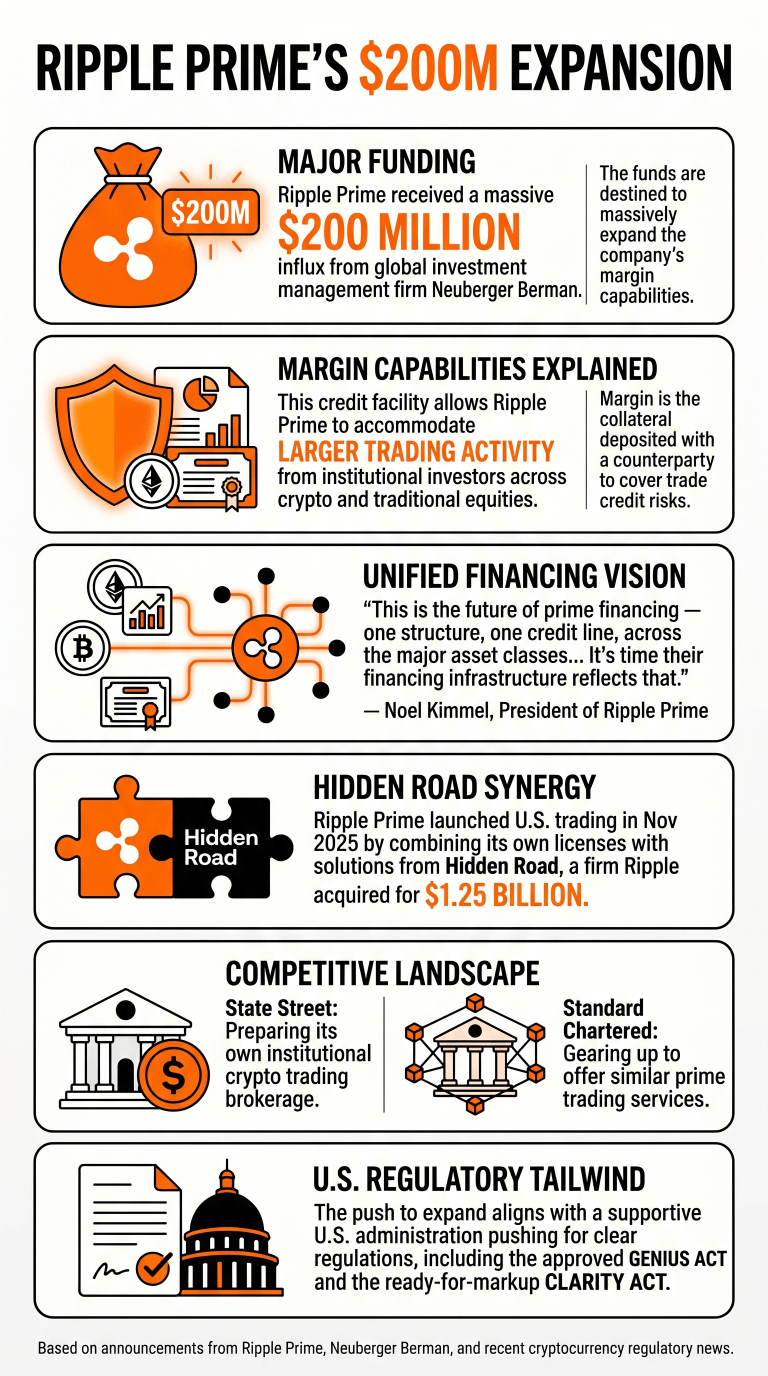
Margin is the collateral that a holder of any financial instrument must deposit with a counterparty to cover credit risks derived from a trade. This credit facility will enable Ripple Prime to accommodate larger trading activity from institutional investors, who can now tap into more liquidity across their financial bets in crypto, traditional equities, and other products.
Riple Prime President Noel Kimmel highlighted the relevance of this development, stressing that the institution’s margin capabilities will be leveraged across several asset classes, enhancing the utilization of these funds under just one roof.
“This is the future of prime financing — one structure, one credit line, across the major asset classes. Our clients don’t operate with siloed risks or portfolios. It’s time their financing infrastructure reflects that,” he stressed.
Ripple Prime aims to be ready for the next expansion in crypto trading as competitors gear up to offer similar services, with State Street and Standard Chartered preparing crypto trading brokerages.
The credit facility marks a major expansion for the brokerage, which just launched U.S. trading in November 2025, combining its own licences with Hidden Road solutions. Hidden Road was acquired by Ripple in 2025 for $1.25 billion in one of the largest acquisitions in the crypto industry.
The push to expand Ripple Prime’s capabilities comes as the current U.S. administration has supported cryptocurrency assets, pushing for clear regulations in the form of the approved Genius Act and the ready-for-markup Clarity Act.