Key Takeaways
- Arthur Hayes has sold his entire ZEC holdings after the Orchard exploit was exposed by an independent cryptographer on June 29.
- The exit added pressure to ZEC, which slid over 47% as confidence in privacy-coin supply cracked.
- Hayes also dumped HYPE and NEAR, rotating toward Worldcoin amid AI IPO and US midterm bets.
A High-Conviction Trade Unwinds
BitMEX co-founder and one of crypto’s most-followed macro voices, Arthur Hayes told his followers he had liquidated his entire ZEC bag in the wake of the Orchard counterfeiting flaw. “The Holy Trinity is dead,” he wrote, adding that while he thinks new counterfeit minting is “extremely unlikely,” it “cannot be formally cryptographically proved impossible.”
For an asset that sells certainty, he suggested, that ambiguity was disqualifying, adding: “the privacy from AI, govt, big tech narrative demands perfection.”
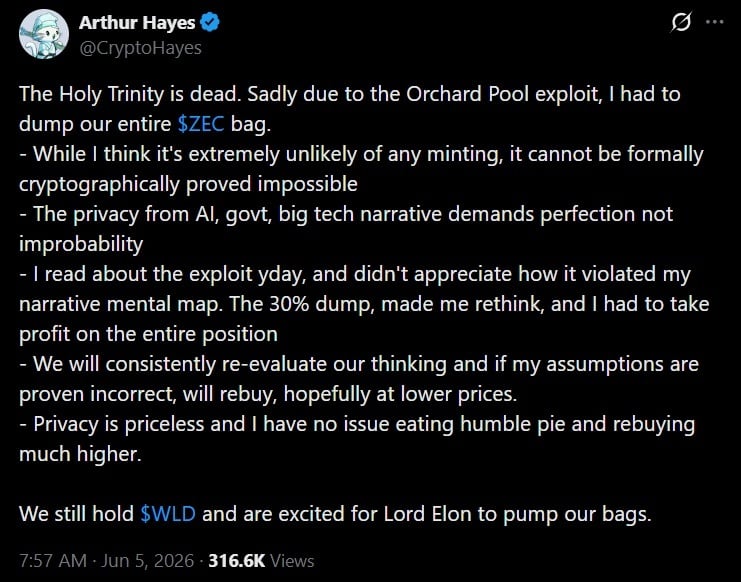
The “Holy Trinity” was Hayes’ own label for a trio of bets he had been championing, anchored by Zcash as the privacy leg. The exploit, disclosed by researcher Taylor Hornby (and confirmed by Zcash founder Zooko Wilcox), broke the thesis with Hornby’s disclosure showing the bug could have allowed an attacker to mint undetectable counterfeit ZEC inside the shielded Orchard pool ad infiniti.
Why the Exit Stung the Market Even More
In the wake of the aforementioned developments, ZEC, which had been one of 2026’s standout performers after surging past $600 and briefly flipping monero by market capitalization, gave back nearly half of its value as the news spread, dipping as low as $264.80.
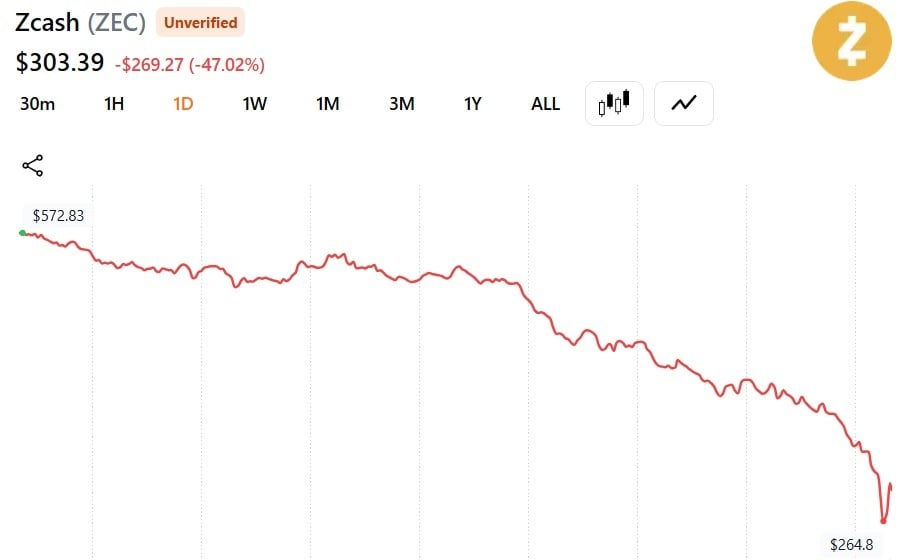
ZEC was not the only position Hayes torched as he offloaded HYPE and NEAR stacks as well, rotating toward Worldcoin (citing a wave of artificial intelligence IPOs and the approaching U.S. midterm elections as reasons to reshuffle).
That said, just days earlier, he staked a $100,000 charity bet that HYPE would beat any top-10 coin by year-end, once again showing how his convictions can flip quickly, even when he insists a longer-term thesis is still alive.
The Privacy Premium Takes a Hit
The deeper damage in all of this has been on the privacy-coin market as Bitcoin.com News recently chronicled how privacy assets returned to favor in 2026 amid a global pushback against financial surveillance, with backers like Raoul Pal describing Zcash as bitcoin’s “younger sibling.”
That narrative leaned on the idea that shielded transactions offer airtight, mathematically guaranteed confidentiality, but a counterfeiting bug (like the one encountered with Zcash) has changed the status quo, giving critics more than enough ammunition for sustained criticism in the week and months to come.
For traders, Hayes’ exit is both a signal and a stress test as some will read his capitulation as a top-tier investor cutting risk, while others will treat the dip as an overreaction to a vulnerability that developers have already closed. ZEC’s recovery will likely track how convincingly Zcash’s team can harden supply verification and reassure a market that just watched its loudest privacy bull walk away.
What is clear is that the episode has reset sentiment, and for ZEC holders, it will be interesting to see if changes or upgrades can bring back trust or whether the market simply moves on to the next narrative, leaving the privacy coin behind in the annals of crypto mythos.