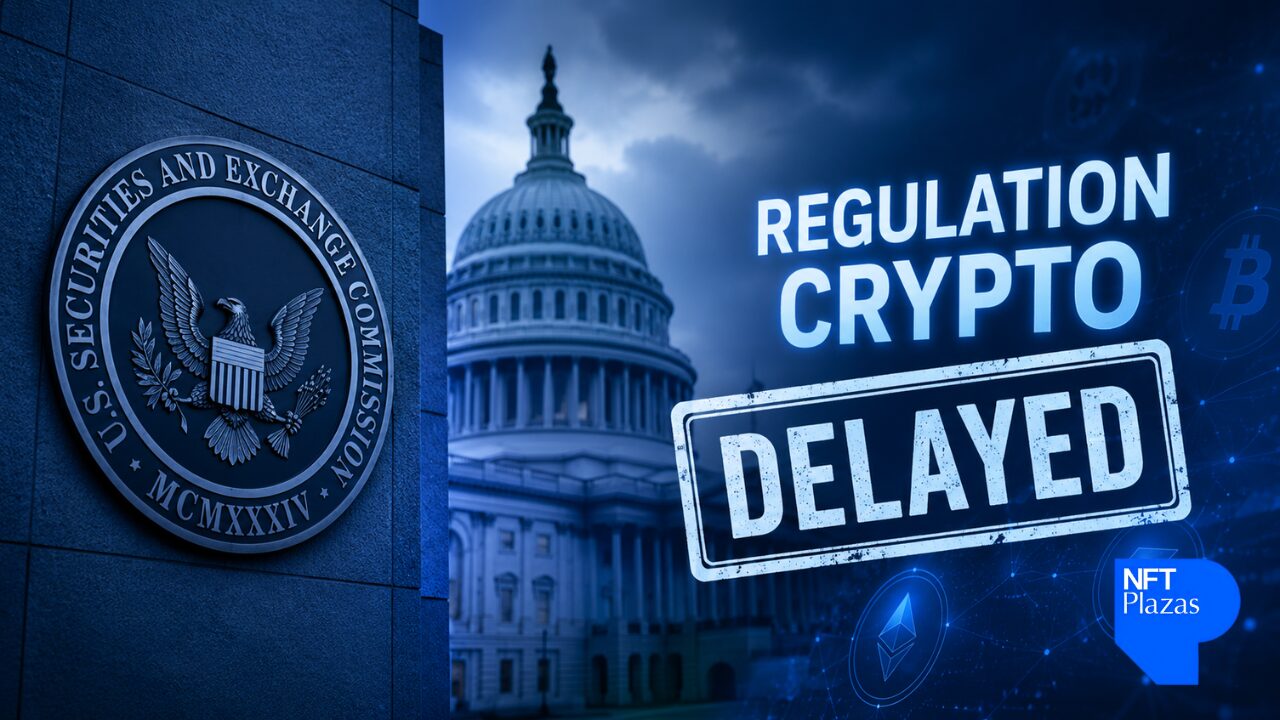
The U.S. Securities and Exchange Commission (SEC) has abruptly canceled an open meeting where commissioners were expected to consider a long-anticipated proposal that could reshape how digital assets are issued and regulated in the United States.
The agency announced late Thursday that Friday’s meeting would be postponed “due to an unforeseen scheduling issue,” with the discussion to be moved to a later date. No new date was provided, leaving the crypto industry once again waiting for clarity on a regulatory framework that SEC Chairman Paul Atkins has identified as a central part of his digital-asset agenda.
The cancellation comes at a sensitive moment for U.S. crypto policy. The Senate has yet to advance the Digital Asset Market Clarity Act, widely viewed by the industry as the legislation that could establish a broader legal foundation for cryptocurrency markets. With Congress temporarily out of session and negotiations still unresolved, market participants had increasingly looked to the SEC to move regulation forward independently.

SEC Cancels Open Meeting, Delaying Long-Awaited Regulation Crypto Proposal
What Regulation Crypto could change
The proposal, commonly referred to as “Regulation Crypto” or “Reg Crypto,” is expected to establish a more tailored framework for certain crypto projects seeking to raise capital.
Atkins has described the initiative as a “tailored offering regime for certain investment contracts.” The concept could allow qualifying digital-asset projects to raise funds without immediately facing the full range of traditional securities registration requirements. It could also provide a pathway for projects to eventually transition away from SEC oversight as they become more decentralized or otherwise meet specified conditions.
Such a framework would represent a significant shift from the SEC’s more enforcement-driven approach of recent years. Rather than relying primarily on case-by-case enforcement actions and policy statements, the agency would be establishing a formal regulatory regime subject to public notice and comment.
For crypto companies, that distinction matters. A defined framework could make it easier to determine when a token constitutes a security, how a project can legally raise capital and what obligations apply as a network evolves.
But the SEC’s decision to postpone the meeting means those questions will remain unanswered for now.
Another setback for tokenization
The canceled meeting was also expected to provide an update on a separate SEC initiative: an “innovation exemption” designed to make it easier to experiment with tokenized securities.
The exemption is intended to reduce regulatory barriers for firms seeking to issue and trade securities using blockchain infrastructure. However, industry sources said the initiative has encountered resistance from both the White House and traditional financial institutions, potentially contributing to another delay.
One concern reportedly centers on whether the SEC has sufficient legal authority to provide such broad relief and whether it has completed the economic analysis and procedural work necessary to support the exemption.
Wall Street firms have raised a different set of concerns. The Securities Industry and Financial Markets Association (SIFMA) has questioned how blockchain-based trading venues, including decentralized platforms and automated market makers, would interact with existing equity-market rules.
One major issue is best execution. Under the existing U.S. market structure, Regulation NMS generally requires brokers to seek the best available protected quotation when executing customer trades. Applying those requirements to decentralized or blockchain-based markets could prove considerably more complicated.
SIFMA has argued that significant market-structure changes should be addressed through an open rulemaking process rather than exemptions or no-action relief.
Why the timing matters
The delay arrives as tokenization rapidly moves from a crypto-industry experiment toward a broader financial-market trend.
Major exchanges including Nasdaq and the New York Stock Exchange have been developing infrastructure for tokenized securities, while the Depository Trust & Clearing Corporation has already processed live production trades involving tokenized securities as part of a test phase. Citi analysts have projected that tokenized assets could eventually become a $5.5 trillion market by 2030.
The SEC has increasingly signaled that it sees blockchain technology as a potential tool for modernizing financial markets. Under Atkins, the agency has pursued a more accommodating approach to digital assets, reversing several policies associated with the previous administration.
In March, Atkins indicated that the SEC was considering a safe harbor and a “fit-for-purpose startup exemption” that could give crypto entrepreneurs greater flexibility to raise capital or operate for a limited period without immediately complying with the full securities regime.
Yet the latest postponement highlights the tension between moving quickly and establishing rules that can withstand legal, political and market scrutiny.
SEC or Congress: Who moves first?
For the crypto industry, the immediate question is no longer simply what the SEC will propose, but whether regulators or lawmakers will deliver the next major piece of regulatory clarity.
The Clarity Act remains stalled in the Senate after lawmakers left Washington for a five-week recess without voting on the legislation. The bill would create federal rules specifically tailored to digital assets and could provide companies with a more definitive legal foundation. However, its prospects have become increasingly uncertain, with negotiations still needing to produce enough support to clear the Senate’s 60-vote threshold.
That leaves the industry in an unusual holding pattern. The SEC appears willing to build a more crypto-specific regulatory framework, while Congress is simultaneously attempting to define the statutory boundaries of the market.
For now, both efforts remain unfinished.
The canceled meeting does not necessarily signal that the SEC has abandoned Regulation Crypto. Instead, it adds another delay to an initiative that could become one of the agency’s most consequential crypto policy moves. Until a new meeting date is announced, digital-asset companies, investors and traditional financial institutions will have to wait to see whether the SEC can turn its emerging crypto agenda into formal rules—or whether Congress ultimately gets there first.