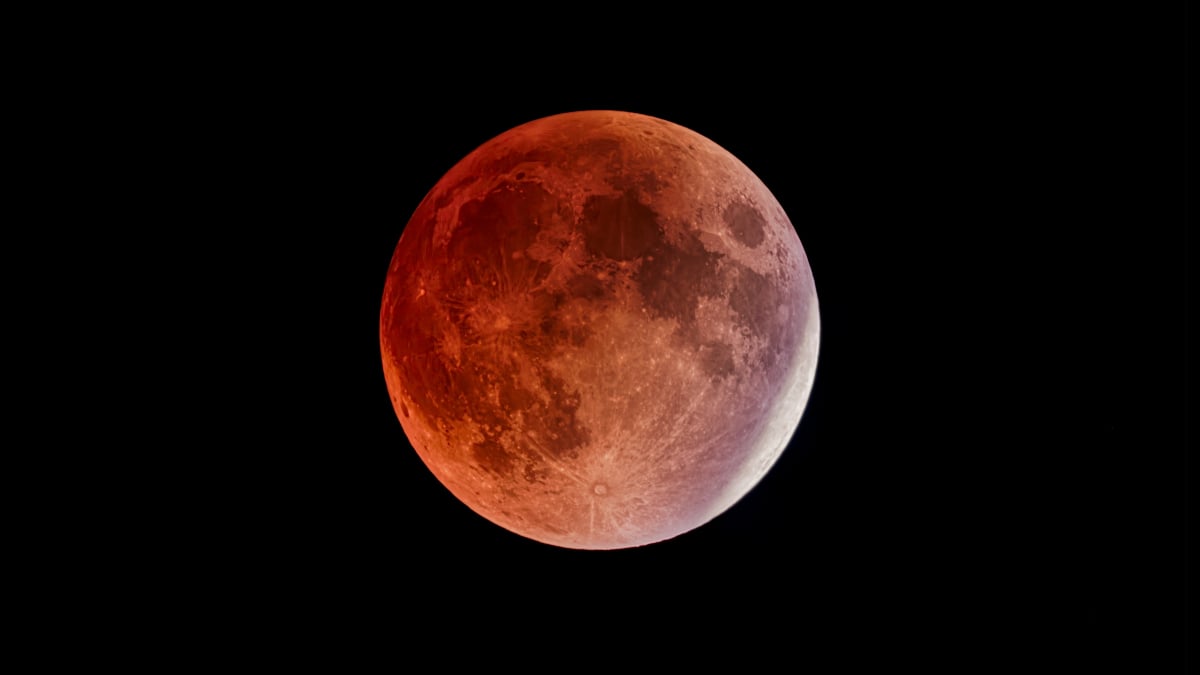
August has been a busy month for celestial events. From the recent solar eclipse, the Perseids meteor shower, and now a partial lunar eclipse will be gracing our skies.
Visible across much of North America this week, sky-gazers will have the chance to watch Earth’s shadow creep across the surface of the full moon. Want to find out more? Keep reading to know when to look up and what to know about the event.
When is the lunar eclipse?
The partial lunar eclipse will take place on Aug. 27–28, 2026, according to Time and Date. It begins on the evening of Aug. 27 and peaks in the early hours of Aug. 28. Timings will vary based on your location, but NASA estimates it to be around 12:13 a.m. ET.
What is a lunar eclipse?
According to NASA, a lunar eclipse happens when the Earth moves between the Sun and the Moon, causing the Moon to pass through Earth’s shadow. Lunar eclipses can only happen during a full moon, when the three bodies are aligned closely enough for Earth’s shadow to fall across the lunar surface.
Mashable Light Speed
This is only a partial eclipse. During a partial lunar eclipse, only a portion of the moon passes through Earth’s shadow. From Earth, the shadowed area can appear noticeably darker against the illuminated part of the moon. Exactly how the eclipse looks depends on the alignment of the Sun, Earth, and Moon.
A total lunar eclipse occurs when the Sun, Earth, and Moon line up, with Earth directly between the other two. The moon still receives a small amount of sunlight, but that light has to travel through Earth’s atmosphere first. The atmosphere scatters much of the blue light, allowing more red and orange light to reach the moon, which is why it can look reddish.
How to see the lunar eclipse
Thankfully, unlike a solar eclipse, a lunar eclipse is completely safe to watch with the naked eye, so you don’t need special glasses or equipment.
The best way to see it is nice and easy: just head somewhere with a clear view of the sky and as little light pollution as possible. Look toward the moon as the eclipse gets underway, and you’ll see Earth’s shadow gradually cover part of its surface.
Binoculars or a telescope will give you a closer look, but they aren’t necessary if you don’t have access to either.