Key Takeaways
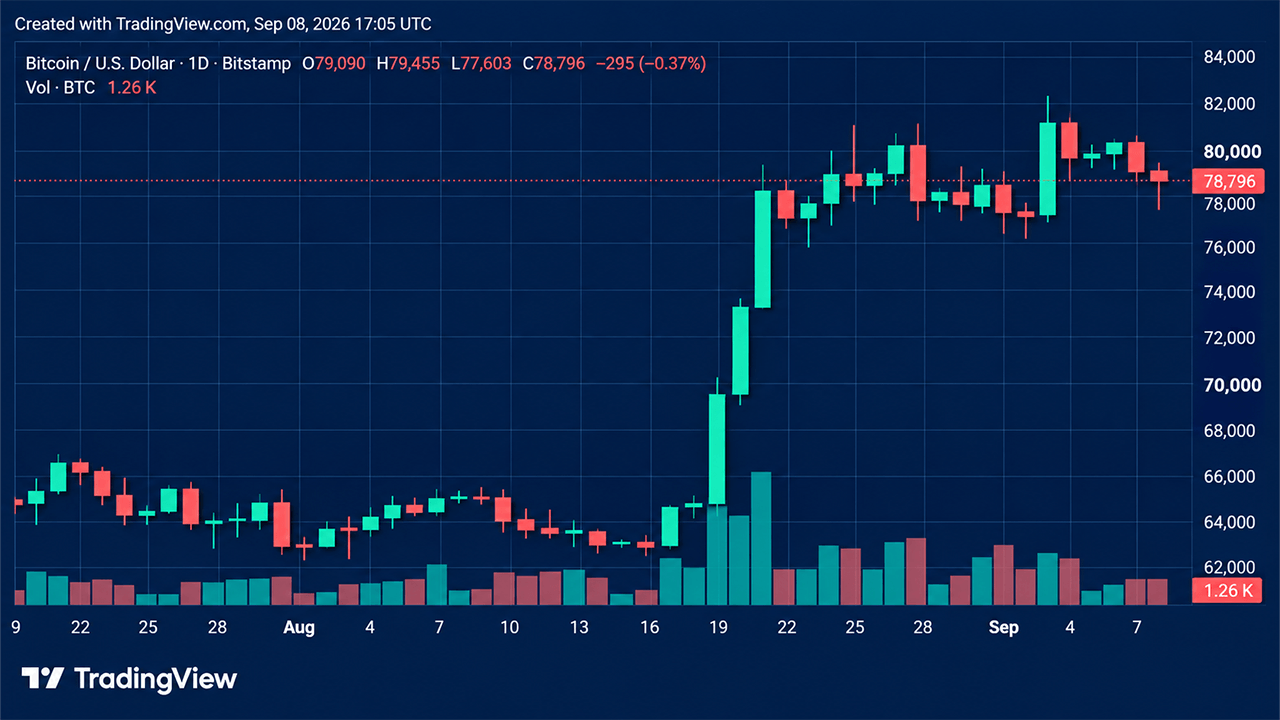
- Bitcoin briefly dipped below $78,000 on Tuesday, hitting a daily low of $77,603 before recovering to $78,600.
- Volatility triggered $264 million in total crypto liquidations, wiping out $79 million in bitcoin positions.
- Markets await August PPI and CPI inflation data from the Bureau of Labor Statistics on Thursday and Friday.
Bitcoin Drops Below $78,000 as August Momentum Cools
Bitcoin briefly dipped below $78,000 on Tuesday, continuing a downward trend after dropping below $79,000 following a weekend above that threshold. The gradual decline, which leaves bitcoin nearly flat in the first week of September, reinforces the notion that bullish momentum has slowed and the debasement trade that drove its August rally has run its course.
Market data shows the cryptocurrency initially shrugged off bearish projections as it traded above $79,000, despite dipping below $78,800 twice. However, shortly before 11 p.m. EST on Monday, the price dropped below $78,000 again, this time without enough buying pressure to reverse the decline.
The downward momentum continued overnight. By 9:50 a.m. EST on Tuesday, bitcoin hit a daily low of $77,603. Although a relief rally pushed the price back above $78,000 to trade around $78,600 by 11:20 a.m. EST, its market capitalization stood at $1.58 trillion.
The price swing since Monday afternoon triggered $79 million in bitcoin liquidations, with long positions accounting for roughly 90% of the wiped-out bets. Across the broader cryptocurrency market, total liquidations reached $264 million, including $187 million in long positions and $77 million in shorts.
Some analysts expect bitcoin to trade sideways in the near term as market participants await key U.S. economic data. The U.S. Bureau of Labor Statistics is scheduled to release the August Producer Price Index (PPI) on Thursday, followed by the Consumer Price Index (CPI) on Friday.
The upcoming inflation prints arrive on the heels of a stronger-than-expected nonfarm payrolls report, which highlighted persistent resilience in the U.S. labor market. If inflation data reflects an unexpected uptick or fails to cool significantly, it would give the Federal Reserve further leeway to pursue a rate hike at its upcoming policy meeting.
Such a scenario poses a distinct headwind for bitcoin and the broader digital asset market. Higher interest rates elevate yields across traditional risk-free assets, such as U.S. Treasuries, suppressing investor appetite for speculative and non-yielding assets. Consequently, a tighter monetary outlook would likely constrain bitcoin’s upward momentum, keeping prices range-bound or pressuring the asset lower in the near term.