Hormuz Crisis Week Five: Saudi East-West Pipeline Now Global Oil Market Lifeline
Saudi Aramco CEO Amin Nasser told analysts on March 10 that full capacity was days away. Bloomberg confirmed the pipeline hit that mark on March 28, 2026. The route runs from the Abqaiq oil processing hub in the east across the Arabian Peninsula to the Red Sea port of Yanbu.
Aramco built it in the 1980s during the Iran-Iraq War for exactly this kind of contingency. In normal times, the pipeline carried between 1.7 and 2.8 million barrels per day (bpd). Conversion of parallel natural gas liquids lines to crude service made the 7 million bpd figure possible.
At full throughput, roughly 2 million bpd feeds Saudi domestic refineries on the west coast. The remaining 5 million bpd moves toward Yanbu for export loading. Ship-tracking data tells a more complicated story.
The five-day rolling average of crude departures from Yanbu sits between 3.66 and 5 million barrels per day, with some peak readings above 4 million. The Yanbu terminal’s nominal loading capacity is estimated at 4 to 4.5 million bpd. Wartime tanker scheduling and tidal windows reduce that figure further in practice.
Saudi Arabia is moving somewhere between 50 and 70% of its pre-war export volumes through this route, according to analyst estimates. The pipeline helps, but it does not make up the full shortfall from Hormuz.
The Strait normally carries roughly 20% of the world’s oil supply. Since U.S. and Israeli military strikes against Iran began in late February, tanker traffic through the waterway has collapsed. Iran has mined sections of the strait in some reports and controls passage for others.
WTI crude closed Friday, March 27, between $99.64 and $101.18 per barrel — a daily gain of more than 5% and a rise of roughly 40% over the past month. Brent settled in a range of $105.32 to $112.57 per barrel. Physical Dubai crude, which reflects actual delivery conditions for Asian buyers, traded near $126 per barrel.
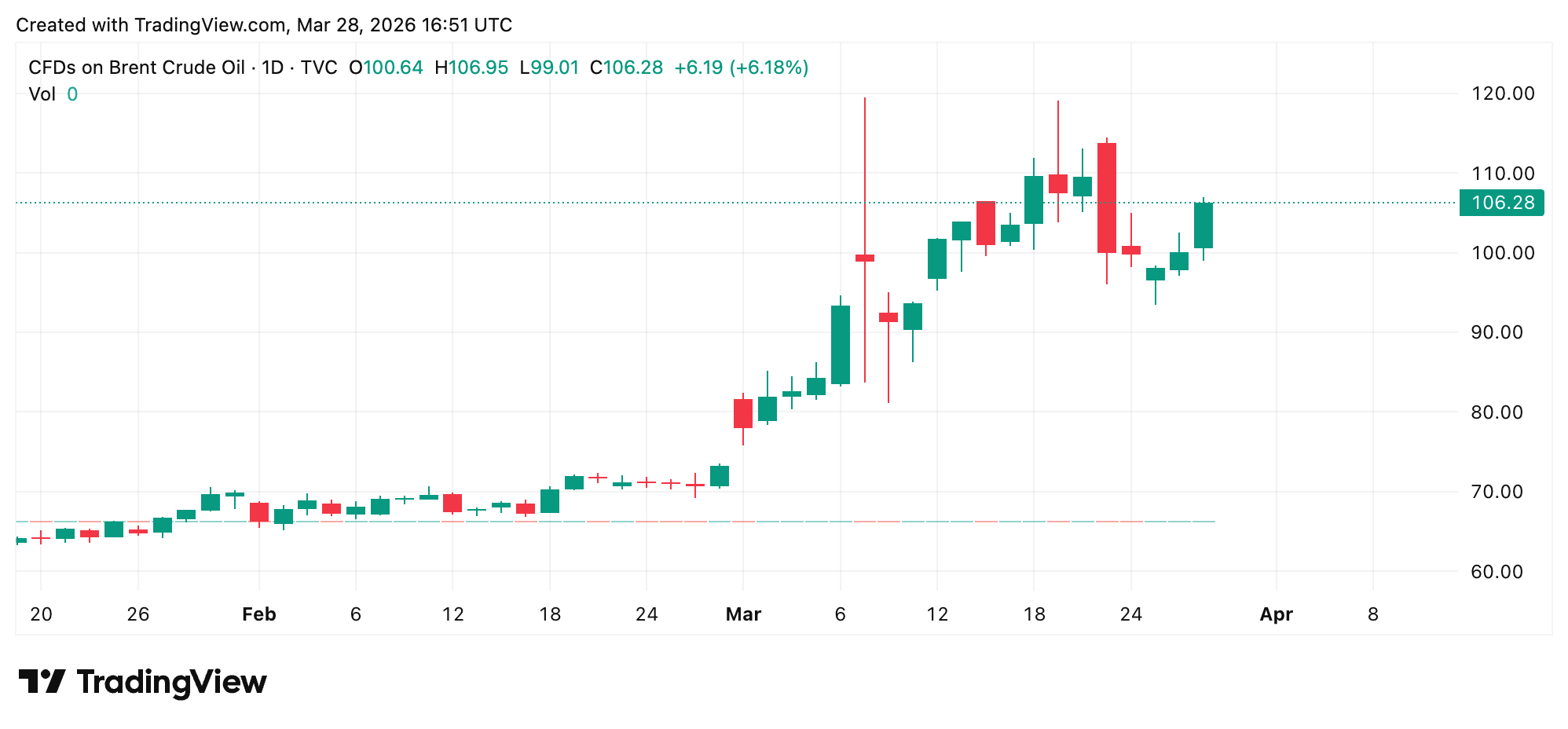
Coordinated strategic reserve releases totaling around 400 million barrels are now underway globally — the largest on record. Analysts at Goldman Sachs and S&P Global have already revised 2026 price forecasts upward. If Hormuz traffic does not recover by mid-April, industry sources warn prices could reach $150 to $200 per barrel in a worst-case scenario.
The UAE’s Habshan-Fujairah pipeline is running a similar bypass operation, providing a secondary outlet for Gulf producers. Together, the two pipelines represent the primary physical alternative to Hormuz for Arabian Peninsula crude exporters.
U.S. retail gasoline averaged between $3.91 and $3.98 per gallon as of late March, with further pressure expected when Monday trading opens. President Trump’s five-day diplomatic deadline for Iran expired around March 28 without a ceasefire or Hormuz agreement. Analysts see no near-term resolution.
Saudi Arabia’s Petroline was rarely operated near full capacity in peacetime. That has changed. It is now one of the most consequential pipelines in the global oil market.
FAQ
- What is Saudi Arabia’s East-West Pipeline? It is a 1,200-kilometer crude oil pipeline running from eastern Saudi Arabia to the Red Sea port of Yanbu, built to bypass the Strait of Hormuz.
- Why is the Petroline running at full capacity in 2026? U.S. and Israeli military strikes against Iran have effectively closed the Strait of Hormuz, forcing Saudi Arabia to reroute crude exports overland.
- How much oil is the East-West Pipeline moving right now? Saudi Aramco confirmed on March 28, 2026, that Petroline is operating at its maximum capacity of 7 million barrels per day.
- Will the Saudi pipeline fix the global oil supply shortage? The pipeline partially offsets the Hormuz disruption but cannot replace the roughly 20% of global oil supply that normally transits the strait.