South Korean cryptocurrency exchange Upbit has temporarily suspended Osmosis (OSMO) deposits and withdrawals after the Osmosis blockchain stopped producing blocks, preventing customers from transferring the token through its native network.
Summary
- Upbit temporarily suspended Osmosis deposits and withdrawals after the blockchain stopped producing new transaction blocks.
- OSMO trading remains available on Upbit despite restrictions affecting deposits and withdrawals through Osmosis Chain.
- QuickNode reported that Osmosis block production stopped at height 74,955,152 on November 12, 2026.
- Bithumb and Coinbase reported separate Osmosis transfer disruptions while cryptocurrency trading services remained largely available.
- Osmosis gained nearly 14% over 24 hours despite declining around 10% during the week.
According to anUpbit announcement published on November 13 at 10:21 a.m. Korean time, the restriction covers deposits and withdrawals involving the Osmosis Chain. However, customers can continue buying and selling OSMO on the exchange.
The suspension follows a network-wide disruption confirmed by blockchain infrastructure provider QuickNode. Other cryptocurrency exchanges, including Bithumb and Coinbase, have reported problems processing transactions on the same network.
Upbit halts OSMO transfers following network failure
Upbit said it suspended the transfer services because Osmosis had stopped generating new blocks, which are necessary for processing and confirming blockchain transactions.
The exchange cited Article 17, Paragraph 1, Subparagraph A of the Enforcement Decree of South Korea’s Virtual Asset User Protection Act as the legal basis for the temporary restriction.
The notice applies specifically to OSMO deposits and withdrawals using the Osmosis Chain. Upbit did not announce a suspension of trading or a delisting of the cryptocurrency.
Customers who already hold OSMO in their Upbit accounts can therefore continue placing buy and sell orders through the exchange’s supported markets.
However, users cannot transfer OSMO from external wallets into Upbit or withdraw their exchange balances through the affected blockchain while the restriction applies.
The company said it would announce the resumption of services after confirming that deposits and withdrawals could be processed safely.
Osmosis network stops producing blocks at height 74,955,152
QuickNode confirmed the blockchain disruption in a November 12 incident report.
The infrastructure provider said Osmosis stopped producing blocks at 22:57 UTC on November 12, with the network stalled at block height 74,955,152.
Its announcement described the problem as a “Network-Wide Stall,” explaining that the interruption affected providers relying on the blockchain.
QuickNode placed the incident under investigation and said its services would begin processing new blocks once the network restarted.
Osmosis operates as a Layer 1 blockchain within the Cosmos ecosystem and supports decentralized cryptocurrency trading and liquidity services.
When block production stops, validators cannot add new transactions to the blockchain. Transfers may remain pending because the network cannot produce the confirmations required to complete them.
Such interruptions can affect both centralized exchange deposits and withdrawals and transactions carried out through wallets and decentralized applications.
The available network reports did not establish the technical cause of the interruption or identify a confirmed security breach.
Bithumb and Coinbase report Osmosis transfer problems
Upbit was not the only cryptocurrency exchange responding to the Osmosis outage.
South Korean competitor Bithumb issued its own OSMO suspension notice on November 13, citing the same interruption in blockchain block production.
Bithumb scheduled its deposit and withdrawal suspension for 8:43 a.m. Korean time, before Upbit published its announcement.
The exchange warned that pending transactions could face processing delays and said transfers would resume once network stability had been confirmed.
Bithumb kept OSMO trading available throughout the disruption, although it cautioned customers about possible price volatility.
Meanwhile, Coinbase reported delayed OSMO transfers in a separate November 12 service notice.
The US exchange said customers were experiencing delays when sending and receiving Osmosis tokens. However, it stated that cryptocurrency purchases, sales and fiat deposits and withdrawals were unaffected.
Coinbase said it was investigating the problem and assured customers that their funds remained safe.
The announcements from several exchanges followed the same network disruption, although each platform published its own service restrictions and recovery arrangements.
Osmosis price rises despite exchange withdrawal suspensions
Despite the network problems, OSMO recorded gains in cryptocurrency trading markets.
According to CoinGecko data, Osmosis traded near $0.03738 on November 13, gaining almost 14% over 24 hours.
The cryptocurrency recorded around $8.8 million in daily trading volume, while its market capitalization stood near $26 million.
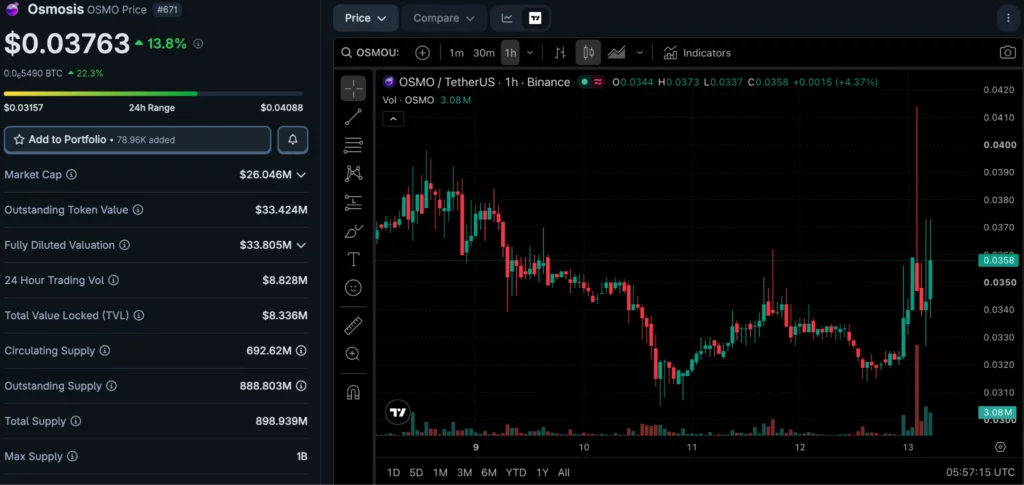
However, OSMO remained down approximately 10% over the preceding seven days, showing that the daily recovery had not erased its weekly losses.
The token’s price movement does not establish that traders welcomed the outage or that the network disruption caused the increase.
Temporary transfer restrictions can leave trading available on centralized exchanges because trades between exchange customers do not require a separate blockchain transaction for every order.
In August, Upbit took a similar precautionary measure when a consensus problem affected Ravencoin, temporarily stopping RVN deposits and withdrawals while keeping trading available.
Upbit’s latest Osmosis notice warned that deposit refund requests and withdrawal address registrations would remain temporarily unavailable during the suspension.
The exchange said it would process pending requests after services resumed, while deposits submitted during the interruption might not appear in customer accounts until the necessary network checks were completed.
Disclosure: This article does not represent investment advice. The content and materials featured on this page are for educational purposes only.

