Key Takeaways
- MSTR absorbs residual bitcoin exposure after senior claims.
- Five preferred securities offer different income protections.
- None gives holders direct ownership of Strategy’s bitcoin.
Strategy Separates Equity From Preferred Income
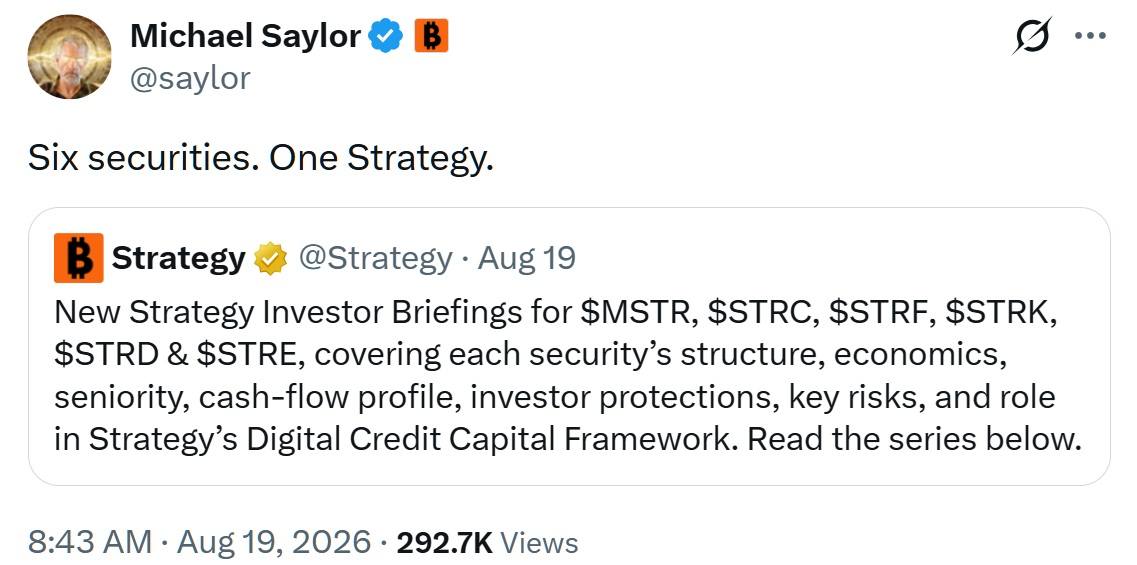
Strategy Inc. (Nasdaq: MSTR) announced Aug. 19 that it had published investor briefings covering its common stock and five preferred securities. Executive Chairman Michael Saylor amplified the release on X, reposting the company’s announcement with a four-word comment: “Six securities. One Strategy.” Each instrument addresses a different investor objective, although all remain exposed to Strategy’s financial condition and capital-management decisions.
Corporate bitcoin strategies commonly fund purchases through common equity, convertible debt, and preferred shares, creating distinct claims and recurring obligations. Companies can raise capital through preferred-stock issuance without immediately diluting common shareholders, although the structure adds recurring dividend payments and senior claims on corporate assets. Strategy’s securities apply that structure across several risk levels rather than providing direct, one-to-one bitcoin ownership.
MSTR occupies the bottom of the capital stack and absorbs gains or losses remaining after debts and preferred claims. The MSTR common-equity structure gives shareholders residual exposure to net reserves plus Strategy’s software and capital-markets businesses. Holders possess no claim on specific bitcoin, while dilution, financing costs, bitcoin volatility, and changes in valuation premiums can amplify results in either direction.
Five Preferred Securities Divide Cash Flow and Seniority
STRC offers a variable, cumulative dividend currently set at 12% annually on a $100 stated amount, with cash payments scheduled twice monthly when declared. The STRC preferred-stock terms allow Strategy to review the rate monthly while pursuing a $99-to-$100 trading objective. STRC remains perpetual, lacks a general $100 repayment date and holds no security interest in the company’s bitcoin.
STRF sits above the other preferred issues, paying a fixed 10% cumulative annual dividend on $100 when quarterly cash distributions are declared. STRK ranks lower and pairs an 8% cumulative dividend with the right to convert each share into 0.1 MSTR share, subject to adjustment. Neither instrument has a scheduled maturity, and both remain junior to creditors and subsidiary liabilities.
STRD carries a 10% annual dividend rate but provides the weakest preferred claim in the lineup. Its quarterly cash dividends are noncumulative, so an omitted payment does not become an arrears obligation. Euro-denominated STRE instead offers a 10% cumulative dividend on a stated amount of 100 euros, payable quarterly in cash when declared, while ranking above STRK and STRD but below STRF and STRC.
High Yields Carry Corporate and Bitcoin-Linked Risks
Strategy’s wider Digital Credit Capital Framework establishes a dollar reserve dedicated to preferred dividends and debt interest, alongside preferred and common-stock repurchase authorizations. The June 29 policy also permits limited bitcoin sales for reserve funding, obligations, and eligible repurchases. Those measures provide liquidity tools but do not transform the preferred securities into collateralized claims on Strategy’s bitcoin holdings.
Saylor’s broader four-part digital money stack places bitcoin at the capital layer and STRC at the digital-credit layer, separating volatile asset ownership from income-oriented corporate securities. That classification reflects Strategy’s design language rather than a legal guarantee. Each preferred share depends on board declarations, legally available funds, market liquidity, and the issuer’s ability to manage its obligations.
Strategy has previously presented STRC as a mechanism for splitting bitcoin-linked corporate economics between residual equity and income-seeking investors. Saylor’s STRC market expansion argument emphasized scale, liquidity, and overcollateralization at the enterprise level. However, the preferred stock itself is unsecured equity, and the company’s bitcoin remains available to satisfy claims across its broader balance sheet rather than pledged specifically to holders.
Investors face several risks beyond bitcoin’s market price, including issuer credit, interest-rate changes, dividend decisions, liquidity, and capital-structure priority. Unlike bonds or dividend-paying stocks, bitcoin does not generate cash flow. Strategy’s preferred securities add potential dividend income to that underlying exposure, leaving returns dependent on the company’s finances, bitcoin’s performance, and management’s capital-allocation decisions.