Investors and industry experts have long worried that the AI industry will expand until it inevitably bursts. And in the wake of a historic midterm election cycle that decidedly challenged the interests of Big Tech, the AI industry is facing enormous strain from all sides.
Former Nvidia CEO Jensen Huang, a leading figure of the AI boom, has gone down in a salacious scandal involving extramarital affairs and accusations of Chinese espionage. SpaceXSI owner Elon Musk invested and lost millions on Republican campaigns during the midterms that he and other Big Tech leaders hoped would open up the floodgates to greater AI infrastructure. OpenAI and Anthropic have been implicated in numerous cybersecurity scandals on top of a domestic mental health crisis. Google, Meta, and OpenAI’s ChatGPT are at the epicenter of a child safety reckoning that could change education and social media forever.
Is the AI reckoning truly here?
A new sweeping lawsuit against the AI industry
The latest challenge the industry is facing down is a lawsuit filed today (Nov. 12) by a safety and civil society groups Public Citizen, Irreplaceable Education Fund, Heat Initiative, and The Alliance for Secure AI. The groups argue that AI’s developers are aware of “imminent and catastrophic risks to humanity” posed by AI and urges courts to freeze the industry’s development completely in the name of public safety.
“Despite endless warnings about the grave risks their products pose to public safety and even civilization itself, AI company executives are rushing to develop and deploy ever-more advanced AI systems,” wrote Robert Weissman, co-president of Public Citizen, in a press release. “We the People should not simply stand by and tolerate AI executives’ unhinged risk-taking at the public’s expense. Our lawsuit asks the court to apply existing law and find the AI corporations’ reckless practices unlawful and freeze further AI development.”
The group argues that companies are risking public safety by developing and releasing products they have admitted are potentially harmful, and that further development can be halted under California’s Unfair Competition Law.
The best tech deal this week
Products available for purchase through affiliate links. If you buy something through links on our site, Mashable may earn an affiliate commission.
Mashable Light Speed
Anthropic CEO Dario Amodei and OpenAI CEO Sam Altman have previously agreed on the need to slow the growth of highly advanced AI systems. In a September essay, Amodei proposed a three-point plan to “pace the frontier” of AI, which Altman later signaled his support for.
“Children have already paid the price for Big Tech prioritizing profit over safety. We’ve watched chatbots push kids toward suicide and AI tools turn their ordinary photos into AI-generated child sexual abuse material,” said Brooke Istook, CEO of child advocacy organization Heat Initiative. “Now these companies are racing to build AI systems they admit they may not be able to control. If that happens, the protections we’ve spent years fighting for won’t be enough.”
Parents band together to protest and demand action
Some believe the country’s incoming Democratic Congress may finally hold tech companies’ feet to the fire. Coinciding with the lawsuit, dozens of survivor parent-advocates sent a letter to California Attorney General Rob Bonta and Delaware Attorney General Kathy Jennings, urging them to compel OpenAI to restructure its corporate structure and board membership to better support safe AI deployment. The group argues the two states, which led a joint investigation into OpenAI’s recent restructuring, could force the AI company into adopting even stronger safety measures.
While the industry debates appropriate regulation and courts mull over the legal system’s power over AI, schools are becoming their own battleground.
In the first education-related lawsuit of its kind, a family is arguing their teen’s access to AI on school-issued Chromebooks posed a life-threatening risk to her mental health.
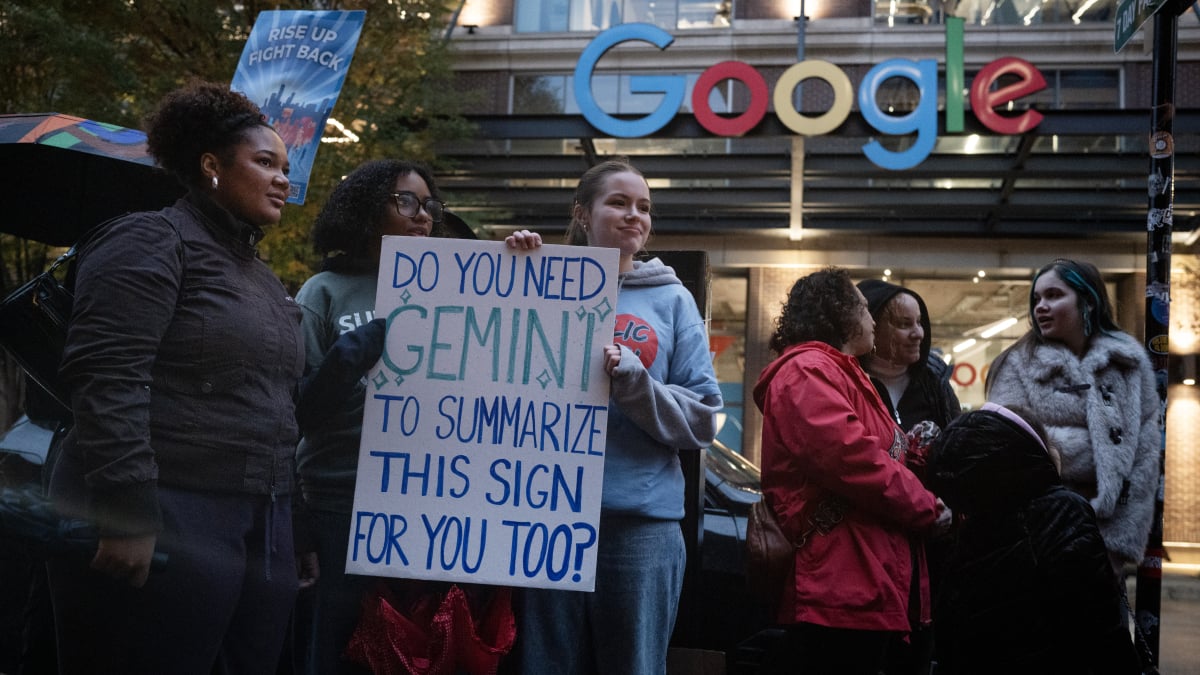
Then on Nov. 11, a coalition of school and child safety groups led nationwide protests over Google’s new controversy-stirring policies for schools. In an announcement a week prior, Google announced that its AI tools would now be opt-in by default, including its AI-powered Search. Because Search’s AI tools can’t be turned off, districts with AI bans would be forced to choose between allowing Search or violating AI guidelines.
Advocates argue that Google’s “ultimatum” presents an opportunity to pressure the tech giant into relinquishing some of its far-reaching AI goals. Many have urged districts to cancel contracts with the company and find AI-free alternatives.