The Trump administration has convened roughly 20 lawmakers, congressional staff members, and law enforcement representatives at the White House as Senate leaders work toward a possible floor vote on the CLARITY Act before the August recess.
Summary
- White House officials met with lawmakers and police groups as support builds for a Senate vote on the CLARITY Act.
- Law enforcement organizations discussed crypto crime enforcement and the Blockchain Regulatory Certainty Act.
- Republicans need at least seven Democratic votes, with senators Mark Warner and Catherine Cortez Masto seen as key swing votes.
According to journalist Eleanor Terrett, the meeting took place on Wednesday at the Eisenhower Executive Office Building and was hosted by Trump crypto adviser Patrick Witt alongside the White House Crypto Council.
Among those attending were House Majority Whip Tom Emmer and White House AI and crypto czar David Sacks, who delivered opening remarks before leaving the session.
Terrett reported that discussions focused heavily on the Blockchain Regulatory Certainty Act (BRCA), a provision contained within the broader CLARITY Act that seeks to provide legal protections for certain blockchain developers and infrastructure providers.
Representatives from several law enforcement organizations also attended the meeting, including the Fraternal Order of Police, the National Association of Police Organizations, the International Association of Chiefs of Police, the National District Attorneys Association, and the National Association of Assistant U.S. Attorneys.
Alongside regulatory questions, participants discussed potential ways to strengthen crypto crime reporting and enforcement tools, according to Terrett.
Democratic support remains a key hurdle
Political support emerged as a central issue during the discussions as lawmakers continue preparing for a Senate vote.
According to Terrett, law enforcement groups may play an important role in reassuring Democratic senators that they do not oppose the bill’s framework, including the BRCA provisions. She noted that support or a lack of opposition from organizations representing police officers and prosecutors could help persuade senators such as Catherine Cortez Masto and Mark Warner.
The Senate arithmetic remains challenging for supporters of the legislation. Republicans do not currently hold enough votes to advance the measure on their own and will require backing from at least seven Democratic senators.
Opposition from some Democrats also remains a factor. Senator Elizabeth Warren has repeatedly criticized crypto-related legislation, creating another obstacle for backers seeking bipartisan support.
Speaking earlier this month, Senator Cynthia Lummis said she expects the CLARITY Act to reach the Senate floor before lawmakers leave Washington for the August recess.
Stablecoin yield debate continues around the bill
Outside the White House discussions, debate over specific provisions within the legislation has intensified.
As reported by crypto.news, Ripple CEO Brad Garlinghouse recently criticized JPMorgan CEO Jamie Dimon for opposing parts of the CLARITY Act. Garlinghouse argued that Dimon had mischaracterized the legislation while lawmakers continue reviewing the proposal.
A major point of disagreement involves language that would permit crypto exchanges to offer stablecoin yield products. Dimon has publicly opposed the provision, while Coinbase CEO Brian Armstrong has defended its inclusion.
Garlinghouse acknowledged that Armstrong speaks on behalf of Coinbase rather than the entire industry, but he said many digital asset companies support legislation that provides clearer regulatory rules for operating in the United States.
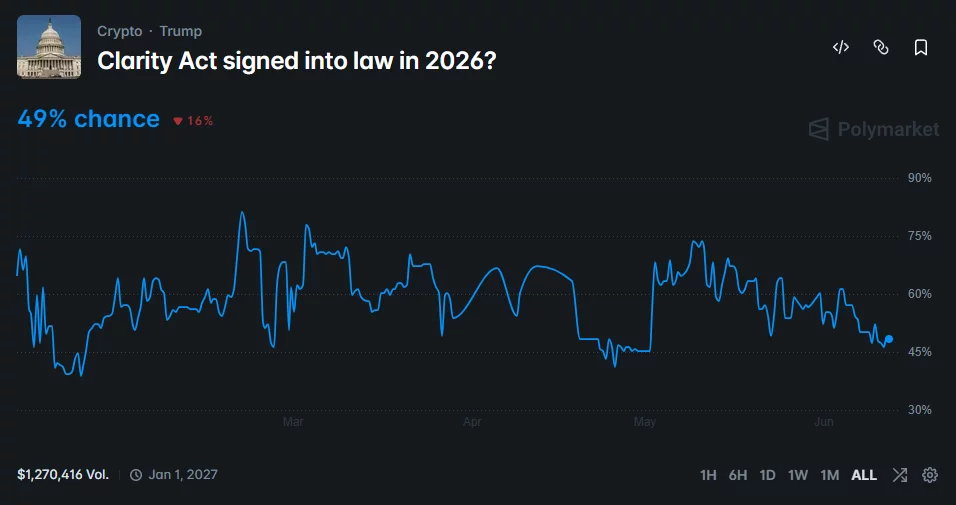
The CLARITY Act has already advanced through committee review and is awaiting further consideration in the Senate. Meanwhile, prediction market data from Polymarket places the odds of the bill becoming law in 2026 at 49%, underscoring the uncertainty surrounding its final path through Congress.