Pi Network has entered a crucial week ahead of its scheduled Protocol 28 upgrade on October 16, 2026, while its native PI token continues trading near $0.08 following a prolonged market decline.
Summary
- Pi Network’s Protocol 28 upgrade is scheduled for October 16, following an October 13 deadline.
- PI traded near $0.08042, declining 2.10% daily and 7.32% weekly, according to supplied CoinGecko data.
- Pi Network confirmed its Open Standard partnership will explore OUSD rewards and ecosystem payment applications.
- PI remained below its four major exponential moving averages, indicating continued bearish momentum on charts.
- Analysts identified $0.075 support and potential resistance between $0.10 and $0.12 for the cryptocurrency token.
Pi Network’s official node documentation confirms that Mainnet operators must upgrade their software to Protocol 28, with the rollout scheduled for October 16. The October 13 deadline for node operators comes as the network continues developing smart contract capabilities and exploring stablecoin applications.
Despite the approaching upgrade, PI has remained under selling pressure, trading at approximately $0.08042, down 7.32% over the past week.
Pi Network prepares for October 16 upgrade
The upcoming Protocol 28 rollout is the latest stage of Pi Network’s 2026 blockchain development schedule. The project began the year with Protocol 19.6 in February, followed by versions 19.9 and 20.2 in March. Subsequent updates introduced technical improvements designed to support more advanced applications and smart contracts.
Earlier in the year, Pi Network confirmed that Protocol 20 established the technical foundation for smart contracts, including applications involving subscriptions, escrow and digital assets. The team said these functions would undergo development, community review and testing before becoming available on Mainnet.
During July, the network prepared Protocol 25, introducing cryptographic features such as BN254 and Poseidon hashing. According to the project’s official announcement, the update was designed to support applications that verify information while keeping selected user data private. Protocols 26 and 27 followed, although earlier rollout schedules were not met as initially expected.
The next planned release, Protocol 28, has attracted attention from Pi community members. X user Giannis Andreou stated that the upgrade was operating on Testnet, with Mainnet activation expected on October 16. He described improvements to transaction data processing and tools that allow developers to update groups of smart contracts together.
Pi Network’s official node page currently confirms that operators must move to version 28. However, the publicly accessible page does not independently verify every technical claim circulating on social media or guarantee that activation will occur without delays.
Pi Network price struggles to recover above $0.08
While development continues, PI has failed to establish a sustained price recovery. According to the supplied CoinGecko market snapshot, the token traded at $0.08042, down 2.10% over 24 hours and 7.32% over seven days. Daily trading volume stood at approximately $6.57 million, while its market capitalization reached $904.1 million.
A subsequent CoinGecko reading showed PI near $0.08072, with trading volume around $6.48 million and a market capitalization of $907.47 million. The token’s 24-hour trading range extended from $0.07792 to $0.08238. Its circulating supply stood near 11.24 billion tokens, according to the retrieved market data.
The latest figures place PI approximately 97.3% below its historical high of $2.99. CoinGecko lists its all-time low at $0.07059, leaving the cryptocurrency trading relatively close to its lowest recorded price.
The supplied daily chart showed PI trading at $0.08064 after a modest 2.48% session gain. Despite that increase, the cryptocurrency remained below levels recorded in late 2025, when it traded above $0.28. Recent price activity showed consolidation near $0.08, with buyers struggling to sustain a move toward higher resistance.
Immediate support appeared around $0.077–$0.078, followed by $0.070. The chart identified resistance between $0.085 and $0.089, making that region an important area for traders monitoring a potential recovery.
Can PI price recover toward $0.10 after the upgrade?
Technical indicators continue to show weakness despite expectations surrounding Protocol 28. In the supplied daily analysis, PI remained below all four major exponential moving averages, suggesting that its longer-term downtrend was still intact.
The 20-day EMA stood at $0.08513, while the 50-day EMA was positioned at $0.08858. Higher resistance appeared at the 100-day EMA of $0.09692 and the 200-day EMA of $0.12736. The positioning of the shorter averages below the longer averages indicated sustained selling pressure at the time of the chart.
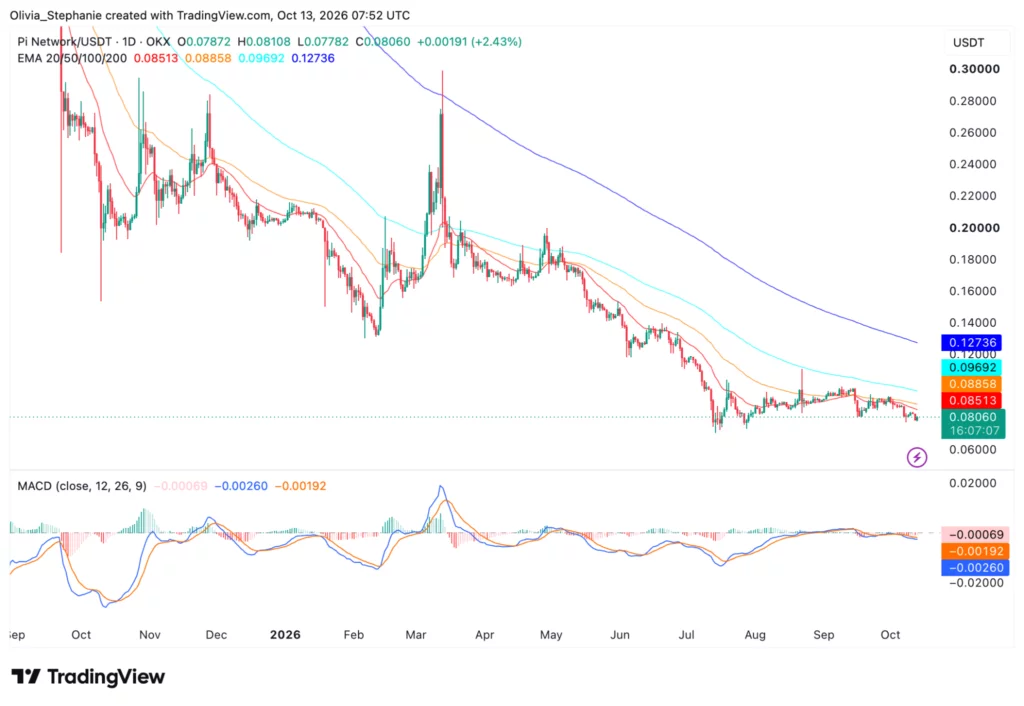
Meanwhile, the Moving Average Convergence Divergence indicator remained negative, with its main line at -0.00260 and signal line at -0.00192. The histogram registered -0.00068, indicating that bearish momentum had not yet reversed.
Crypto analyst Crypto With Gopal suggested that PI could be forming a double-bottom pattern after its prolonged decline. He identified support between $0.075 and $0.085, while describing $0.10–$0.12 as a possible recovery target if buyers regain control.
“Buyers are attempting to stabilize price, but a bullish reversal is not confirmed yet,” the analyst said.
He cautioned that losing $0.075 would weaken the proposed recovery pattern. His assessment remains a technical scenario, not confirmation that PI will rebound following the network upgrade.
The analysis comes as the Pi Network price recovery outlook remains closely tied to resistance near $0.09 and the approaching protocol release. Earlier October market readings placed PI near $0.0812 after a weekly decline of approximately 10%, with bearish technical indicators continuing to influence trading activity.
Pi Network explores OUSD stablecoin payments and rewards
Beyond Protocol 28, Pi Network has confirmed plans to explore stablecoin applications through its partnership with Open Standard, the company behind Open USD (OUSD). The project explained on October 8 that the collaboration would examine potential rewards for Pioneers and additional uses for stablecoins within its ecosystem.
The company said PI would remain the primary cryptocurrency used across its network, while stablecoins could support services requiring predictable payment values. Proposed applications include commerce, payments and transactions where price fluctuations could complicate settlement.
Open Standard operates a consortium involving more than 200 companies, with its OUSD model designed to share reserve income among participating partners. Pi Network said its collaboration would examine possible reward arrangements, although it has not announced eligibility requirements, payment amounts or a launch date for OUSD on Pi Mainnet.
The Pi Network OUSD partnership remains at an exploratory stage. The agreement does not establish that OUSD is already available through Pi applications or that stablecoin usage will directly increase demand for PI.
Pi Network has continued expanding its developer infrastructure during 2026. In September, the project introduced additional tools, including local storage support for selected applications, access to staking-related data and improved developer documentation.
The project previously released a Testnet RPC server in April to help developers build and test smart contract applications. Its development plan includes security reviews, community testing and staged deployment before contracts can become available on Mainnet.
The Core Team has stated that subscription, escrow and NFT-related smart contracts are among the categories being considered. Each category must pass the required review and testing stages before Mainnet deployment.
Community expectations have grown around the scheduled October 16 upgrade. X user Sunday Peter claimed that the coming days could become a “massive turning point” for the project, citing protocol development, smart contract testing and proposed commercial collaborations. His statement represents a community assessment, not an official forecast from Pi Network.
In its October 8 statement, the Core Team said stablecoin integration would require further technical planning and compliance consideration. The project has not published a final implementation design, commercial launch schedule or specific reward terms for the Open Standard partnership.
Disclosure: This article does not represent investment advice. The content and materials featured on this page are for educational purposes only.