Key Takeaways
- Defillama data shows stablecoins lost $12.4B since May 17, 2026, marking the biggest pullback since 2022.
- Tether’s USDT held $184.1B as Sky’s USDS dropped 12.3%, revealing widening issuer divergence.
- Global Dollar’s USDG climbed 9.08%, signaling yield and utility may drive the next phase of competition.
Stablecoin Market Sheds More Than $12 Billion Since Mid-May
The fiat-pegged crypto coin sector, as tracked by defillama.com on Saturday, Jul. 18, shows that more than $1.5 billion in stablecoin value has exited the market since Jul. 11. In fact, the pullback has totaled more than $12 billion in outflows over the past 62 days, dating back to May 17, 2026. It’s one of the largest contractions the stablecoin sector has seen in over four years.
The Biggest Players Barely Blink
This week, Tether‘s USDT still wears the stablecoin crown with a $184.055 billion market cap, while Circle’s USDC follows at $73.376 billion. The two heavyweights barely blinked over the past week, with USDT easing 0.06% and USDC slipping 0.04%. Sky’s USDS holds third place at $6.66 billion but took the hardest hit among the top 10 stablecoins, tumbling 12.30%.
Dai (DAI), World Liberty Financial’s USD1 and Ethena’s USDe fill out the middle of the pack, with USD1 falling 4.59% over the past week and Sky’s DAI edging 0.43% lower. Global Dollar’s USDG stole the show with the strongest weekly performance among the top 10, climbing 9.08% to a $3.164 billion market cap. Paypal‘s PYUSD also joined the winners’ circle, adding 1.60% to reach $2.877 billion.
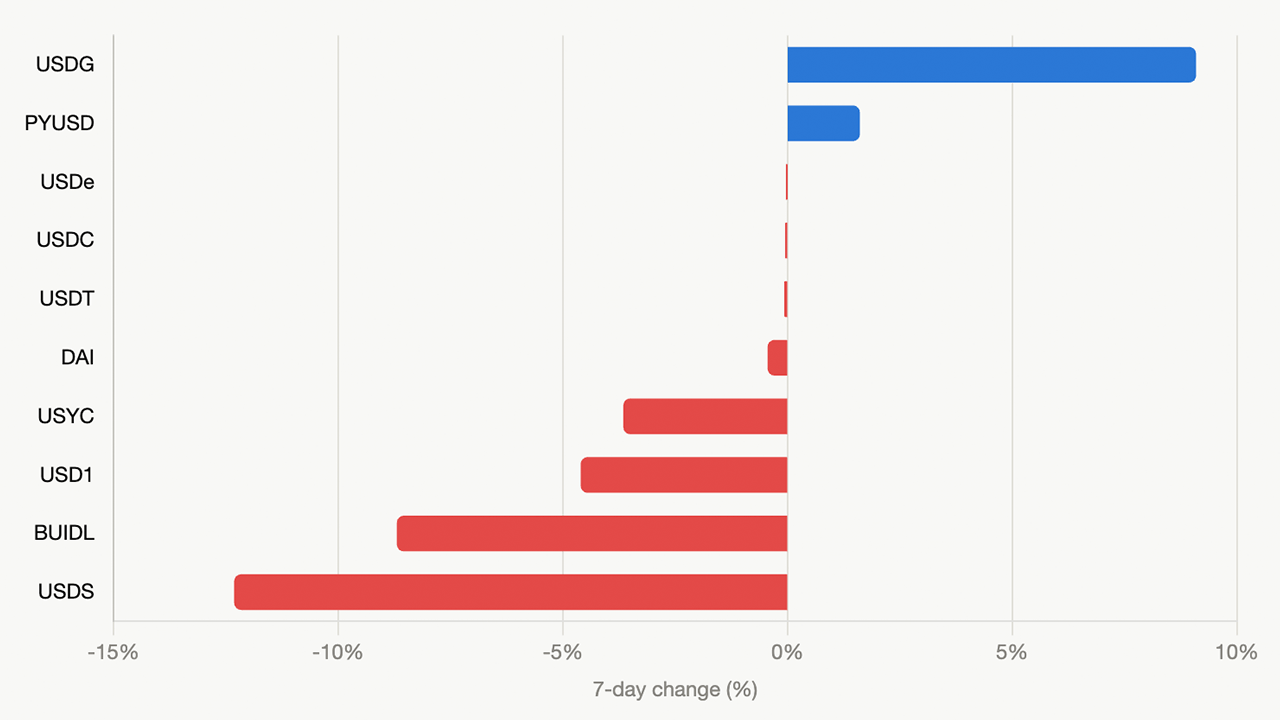
Circle USYC and Blackrock’s BUIDL headed the other way, slipping 3.64% and 8.68%, respectively, leaving BUIDL with a $2.633 billion market cap. The mixed showing across tokenized treasury and yield-bearing stablecoins suggests this slice of the market is still sorting itself out, even as the two largest fiat-backed issuers barely broke a sweat.
Why the Timing Matters
The timing is the giveaway. This contraction began in mid-May and picked up speed during a stretch when bitcoin and most major altcoins largely held their ground instead of unraveling. That separates the stablecoin pullback from the usual “risk-off panic” narrative. If fear were truly calling the shots, you’d expect the decline to move in lockstep with a broader market selloff. So far, that script hasn’t played out.
More Competition, Less Cash Parking
That shifts the conversation away from a simple bearish interpretation. The bigger story may be a stablecoin market that’s growing up, where issuers increasingly compete on yield, features and utility instead of merely offering a digital parking space for dollars.